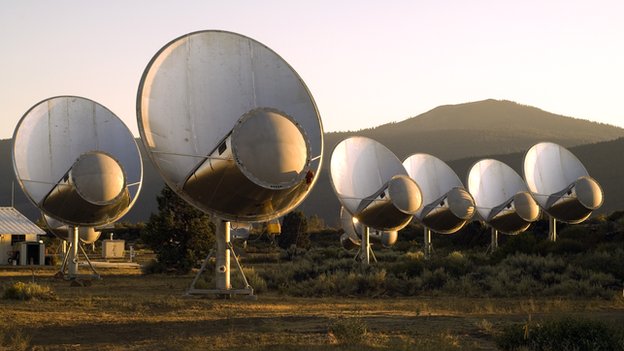
Seti listens out for signals using its own radio telescope array at Hat Creek in California
At long last, Scientists at a US science conference have said it is now time to actively try to contact intelligent life on other worlds. (I am not sure why its only now they have decided this).
Researchers involved in the search for extra-terrestrial life are considering what the message from Earth should be.
The call has been made by at the American Association for the Advancement of Science meeting in San Jose.
But others argued that making our presence known might be dangerous.
Researchers at Seti have been listening for signals from outer space for more than 30 years using radio telescope facilities in the US. So far there has been no sign of ET.
The organisation’s director, Dr Seth Shostak told scientists at the AAAS meeting that it is now time to step up the search.
“Some of us at the institute are interested in ‘active Seti’, not just listening but broadcast something maybe to some nearby stars because maybe there is some chance that if you wake somebody up you’ll get a response,” he told BBC News.
The concerns are obvious, but sitting in his office at the institute in Mountain View, California, in the heart of Silicon Valley he expresses them with characteristic, impish glee.
Game over?
A lot of people are against active Seti because it is dangerous. It is like shouting in the jungle. You don’t know what is out there, you better not do it. If you incite the aliens to obliterate the planet, you wouldn’t want that on your tombstone, right?”
I couldn’t argue with that. But initially, I could scarcely believe I was having this conversation at a serious research institute rather than a science fiction convention. The sci-fi feel of our talk was underlined by the toy figures of bug-eyed aliens that cheerfully decorate the office.
But Dr Shostak is a credible and popular figure and has been invited to present his arguments at America’s largest gathering of scientists at the AAAS meeting.
Leading astronomers, anthropologists and social scientists are gathering at his institute after the AAAS meeting for a symposium to flesh out plans for a proposal for active Seti to put to the public and politicians.

Seth Shostak on search for extra-terrestrial life: “Just send it all, because if you send a lot of information there’s some chance they’ll figure it out”
High on the agenda is whether such a move would, as he put it so starkly, lead to the “obliteration” of the planet.
“I don’t see why the aliens would have any incentive to do that,” Dr Shostak tells me.
“Beyond that, we have been telling them willy-nilly that we are here for 70 years now. They are not very interesting messages but the early TV broadcasts, the early radio, the radar from the Second World War – all that has leaked off the Earth.
“Any society that could come here and ruin our whole day by incinerating the planet already knows we are here.” ~ Seth Shostak

Clash of cultures
His argument isn’t entirely reassuring. But neither is the one made by David Brin, a science fiction writer invited to speak at the AAAS meeting, who opposes the plan.
“Historians will tell you that first contact between industrial civilisations and indigenous people does not go well,” he told me.
Mr Brin believes that those in favour of active Seti have been “railroading” the public into sending a message without a wide and detailed discussion of what the cultural impact might be”
He does not fear a Hollywood-style alien invasion and thinks the likelihood of making contact is extremely low. But the risks, he argues are extremely high and so merit careful consideration before anyone sends out a signal to potentially habitable worlds.
David Brin is arguing for a wide and detailed consideration of active Seti involving the public and government’s across the world because it is a decision that he believes affects the entire planet.
“The arrogance of shouting into the cosmos without any proper risk assessment defies belief. It is a course that would put our grandchildren at risk,” he said.
Also on the agenda at the active Seti symposium is that if we are to send a message to ET – what should it be?
Some involved in the discussions believe we should send a sanitised account of ourselves, leaving out parts of our history we aren’t proud of and putting a positive spin on our achievements – as if our species were attending a job interview or first date. Dr Shostak disagrees. He thinks the only way to win over the aliens is to be ourselves.
“My personal preference is to send the internet – send it all because if you send a lot of information then there’s some chance that they’ll work it out”.
UIP Summary
Right I guess first things first, yes there are some great thoughts above reference what ‘could’ possibly be the risk factor of making other beings out there aware of our existence! And yes this is true there could be Alien beings out there who could see us in a negative light! But I guess one of the strangest thing’s about all of this talk is the fact that the world IS talking about UFO’s and aliens more than ever and these types of headline stories were hardly ever seen in the past! Yes technology has I proved vastly and Yes I guess science has stepped up a notch, but I also feel that we are being drip fed disclosure DAILY now and that the people in control (at the moment) are setting the scene for Disclosure!
I guess on the flip side of all this, sending out constant signals deep into space could quite possibly attract the WRONG attention, perhaps some alien species which is even more violent that the human race! So we have to be careful about who we call out too, but that is the thing right, there is absolutely zero control of whom you may attract from these signals! It is kind of clear that we are already being visited and as of yet they have not chosen to speak to us directly, but then again when looking at the state of the world……Do you blame them!?
We can all agree that it is great seeing the word ‘Extra-terrestrial’ in the news feed BUT we need to look at the possible repercussions of this, and not how it will necessarily affect us, but perhaps in year to come it could affect our children’s children…..Hopefully for the better!
UIP