


The Game Changer For Seeking Alien Life In Space: PLANTS?

Could we be about to see a game changer as far as it comes to hunting out Habitable Planets in space? Very possibly! The light coming from far away distant solar systems could reveal the existence of plants growing on other planets, according to leading astronomers. Plants create Oxygen, Oxygen creates LIFE!
With this potential ground breaking way of seeking out life in space, this could very mean that we could soon start filtering out the difference between light that has been reflected by living plants on a planet’s surface.
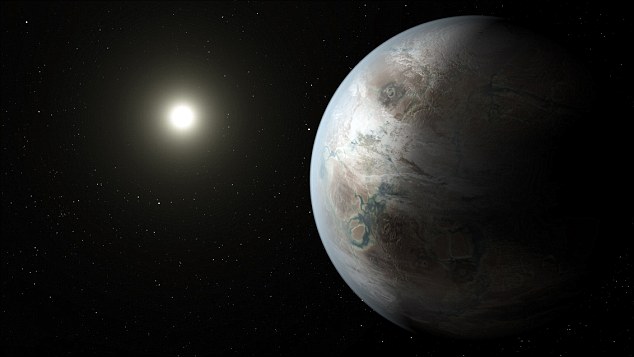
Light reflected from the surface of planets orbiting their stars could provide clues as to whether there is plant life, algae or bacteria growing on the surface, according to the latest research
This potentially could be a ground breaking way of discovering Alien life in space, without having to depend on listening out for unknown radio signals from potential habitable planets.
Astrobiologist’s could now be able to discover potential inhabited Planets by looking at the colour of planets surrounding stars in space, caused by photosynthetic organisms. This could also help to identify planets which may be habitable by humans – photosynthesis produces oxygen as a key by product.
Leading researchers could even be looking at using this new technique to search for signs of life on the planets orbiting our nearest stars including Alpha Centauri A and B, which are 4.37 light years from Earth.
Professor Sventlana Berdyugina, from the University of Freiburg in Germany and a scientist at the University of Hawai’s Nasa Astrobiology Institute, recently confirmed that:
‘Photosynthesis, which provides organisms with the ability to use light as a source of energy, emerged early in the evolution of life on Earth.
‘The ability to harvest such a significant energy resource could likely also develop on inhabited exoplanets.
‘Our results demonstrate that linearly polarized spectra provide very sensitive and rather unambiguous detection of photosynthetic pigments of various kinds.
‘Our work paves the path towards analogous measurements of microorganisms and remote sensing of microbial ecology on the Earth and of extra-terrestrial life on other planets and moons.’
As much as A LOT of us KNOW that there is life beyond planet earth and have seen evidence of this ourselves in the skies above us, this could be a sure way of determining WHERE the Extra-terrestrials live near us!
All Plants, bacteria and algae use a variety of photosynthetic pigments to help them capture energy from the sun and use it to convert Carbon dioxide gas and water into oxygen and sugar.
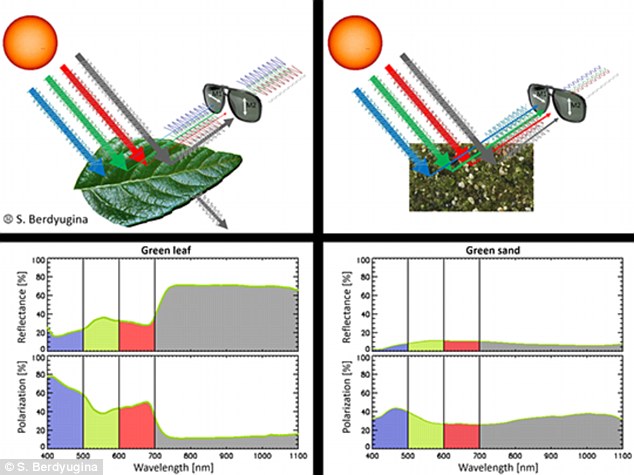
Scientists found the light reflected by photosynthetic pigments in living organisms such as plants have a distinctive polarisation that can be distinguished from the light reflected by sand, rock, water or minerals (illustrated above). By searching for this fingerprint, it may be possible to detect plant life on other planets
(Daily Mail Online reference)
U.I.P SUMMARY – The leading Scientists running with this new project have presented live models and diagrams of exactly HOW reflected off distant Earth-like worlds elsewhere in the galaxy would enable them to spot photosynthetic signatures on the planets, which could lead to the discovery of LIFE beyond Planet Earth!
This could mean that even the closest stars to Earth, Alpha Centauri A and B could very soon be checked by powerful telescopes for actual physical living BREATHING life. This would mean that it no longer comes down to just ‘guessing’ what existence is possibly out there, by gauging what distance from the star the Exo-planets are or lets say how old the planet is!
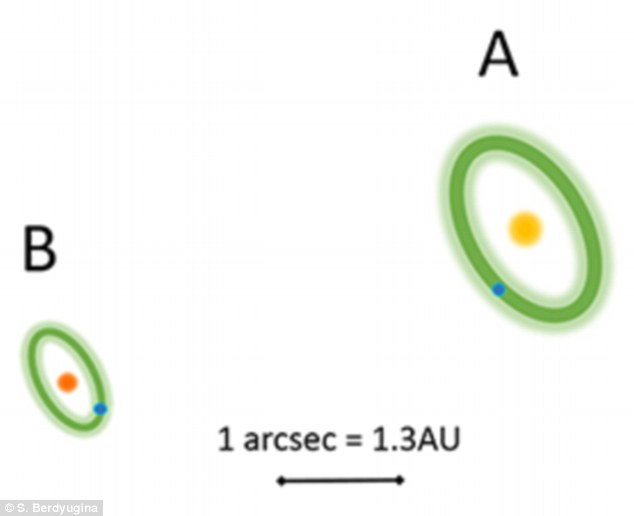
The closest stars to Earth, Alpha Centauri A and B, have habitable zones highlighted in green around them in the image above stars with their habitable zones (green ovals) as seen projected on the sky. It may now be possible to detect photosynthetic pigments on planets in the habitable zones (blue dots) with the new technique
This could be a step in the right direction of actually distinguishing WHAT planets may actually have life on them, in order for us the human race to build a clearer understanding of WHERE the other civilizations out there…..in effect this could be a big step towards getting a clearer idea of WHERE some of our ET visitors are coming from (although I feel some organisations/governments on Earth already know).
This could be a FURTHER way of drip feeding disclosure to us all and this technique has ALREADY helped discover other potential civilized Worlds…..Always keep an open mind as to what THEY tell us and want us to believe!
MWV – U.I.P

Are we soon about to discover other habitable worlds out there!?